
The Fourth Transformation’s Victims: Measles, Children, and the Politics of Blame
How AMLO’s ‘Fourth Transformation’ gave Mexico its worst measles outbreak in a generation — and why Claudia Sheinbaum hopes no one will do the math

Mexico has not had a domestic measles death in nearly three decades. Then came Morena’s Fourth Transformation.
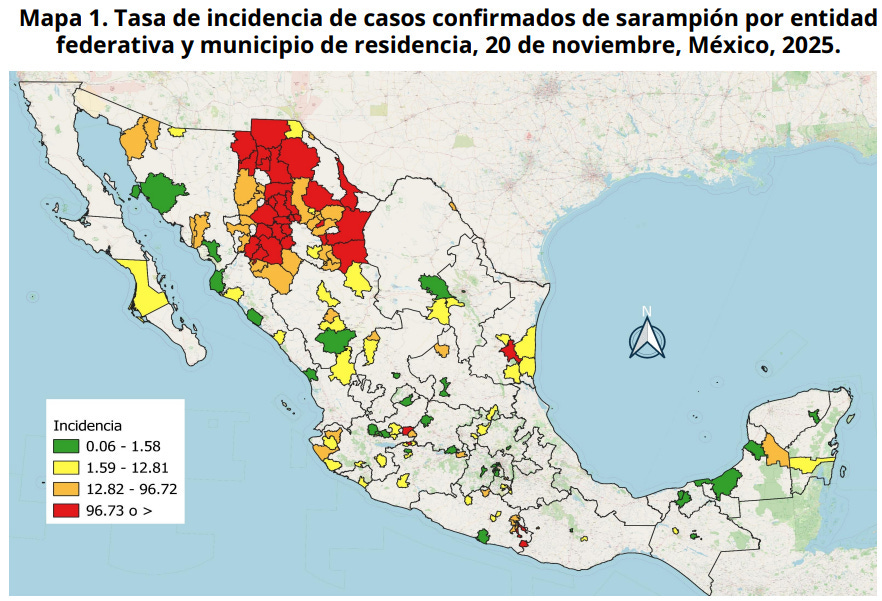
By early March 2026, Mexican health authorities had confirmed more than 9,000 measles cases since the beginning of 2025, with 28 people dead across seven Mexican states. The outbreak has spread to all 32 of Mexico’s federal entities. A panel of independent experts convened by the Pan American Health Organization is now expected to decide whether to formally revoke Mexico’s measles-free status, a designation the country had held since 1996. The irony is devastating: the government that marketed itself as Mexico’s great defender of the poor presided over the policy choices that left those same people exposed to a disease their parents’ generation had eliminated.
What Happened
Mexico’s measles story begins not with a virus but with a budget. Andrés Manuel López Obrador (AMLO) took office in December 2018 promising to transform Mexico in the tradition of its great historical upheavals. He called his project the Fourth Transformation. Central to its rhetoric was a commitment to the poor, to sovereignty, and to dismantling the corrupt neoliberal apparatus that had, in his telling, mismanaged the country for generations.
What he did to the vaccination program tells a different story. In 2019, his first full year in office, the federal government cut public spending and delayed pharmaceutical procurement, including vaccines. That year, 1.5 million Mexican children between the ages of one and six who were scheduled to receive the measles vaccine did not receive it. The disruption did not stop there. Under Morena’s broader governance, the Health Secretariat, the public institution responsible for serving Mexico’s poor, consumed only half of its allocated budget in 2023.
The 2025 federal budget then arrived with an 11 percent cut to healthcare spending overall, a 34 percent cut to the Secretariat specifically, and a nearly 70 percent cut to the Secretariat’s vaccination program: ten billion pesos, roughly $533 million USD, eliminated. Sheinbaum thus inherited a structurally weakened health system from AMLO but then further weakened it in the name of fiscal consolidation, just as the measles outbreak was beginning. Both governments bear responsibility, but at different moments and for different decisions.
A peer-reviewed analysis of Mexico’s measles-mumps-rubella program covering 2006 to 2024, published in 2025, found the cumulative damage. Of the 91.6 million MMR doses required over that period, only 69 million were administered, a deficit of roughly 22.5 million doses, representing 25 percent of the target population left unprotected. The study found that official government coverage figures were systematically overestimated. The numbers the government reported did not match what was happening on the ground.
The outbreak that began in Chihuahua in early 2025 did not create this vulnerability. It merely found it.
Who Got Sick and Why
The first confirmed case in the current wave was a nine-year-old Mennonite child in Chihuahua, whose family had recently returned from Gaines County, Texas. That detail matters: Mennonite communities in northern Mexico have vaccination rates estimated at 40 to 50 percent. The virus did not linger in one community. It spread immediately to other unvaccinated populations nearby, including indigenous groups and migrant farmworkers who travel during harvest season and have chronically limited access to health services. Eleven of Mexico’s first 14 measles deaths involved indigenous people. Three involved Mennonites. The rural and indigenous poor, the people AMLO’s MORENA claimed as his constituency, absorbed the worst of what his government’s choices produced.
By the end of 2025, Chihuahua alone had recorded more than 4,400 confirmed cases, nearly three times the total recorded across the entire United States that year. The outbreak had spread to 29 states and 207 municipalities. The death toll reached 24 by year’s end, 21 of them in Chihuahua.
The Bienestar Contradiction
AMLO’s signature domestic program was Bienestar (Wellbeing). The name was not incidental. It was a statement of governing philosophy: that his administration existed to deliver tangible improvements to the lives of ordinary Mexicans, particularly those left behind by the technocratic governments that preceded him. The Bienestar program channelled cash transfers directly to beneficiaries, bypassing intermediary institutions that AMLO regarded as corrupt. He called this “republican austerity,” the discipline of eliminating waste and redirecting resources to the people who needed them. Sheinbaum continues and uses Bienestar as a mantra for most of her policies.
The measles data reveal what republican austerity looked like in practice. The institutional infrastructure responsible for vaccinating children, the Health Secretariat, its procurement systems, its supply chains, its field personnel, was precisely the kind of apparatus AMLO regarded with suspicion. He cut it. He cut it not because it was failing but because cutting bureaucratic expenditure was, in his framework, inherently virtuous. The cash transfers continued. The vaccines did not.
The result is a case study in what happens when a government dismantles delivery infrastructure in the name of the people it claims to serve. Bienestar transferred income to entice voters. It did not replace the public health system that had, for three decades, quietly ensured that children in rural Chihuahua were vaccinated against a disease that, before the MMR era, killed tens of thousands of Mexicans annually. That system required maintenance, procurement, trained personnel, and sustained funding. Under AMLO, it received none of those things, and it is barely reversing under Sheinbaum.
The party slogan AMLO and Sheinbaum incessantly repeat is "Por el bien de todos, primero los pobres" — "For the good of all, the poor come first."
Where Sheinbaum Fits
Claudia Sheinbaum took office in October 2024 and has governed with a style her predecessor lacked: some say that it is semi-competent technocratic management wrapped in the same ideological frame. She is a climate scientist and a former mayor of Mexico City. She does not govern by improvisation. She is extremely deliberate and has, on several fronts, quietly corrected some of AMLO’s excesses.
On the measles crisis, her government’s public posture has been notably careful. At her morning press conferences, she has urged calm, noted the availability of 28 million vaccine doses, and insisted that most Mexicans are already protected. These are defensible points. What she has not done is acknowledge the causal chain running directly through her party’s years in government.
Sheinbaum herself pushed back on critics, claiming: “There have been claims on social media that the budget is decreasing, which is false; it is increasing. Where does it increase the most? In IMSS-Bienestar. If we add together all health-related spending, the Ministry of Health, IMSS-Bienestar, IMSS, and ISSSTE, the overall budget rises.” Independent analysts at CIEP rejected that framing: per capita spending for those without social security — covered by IMSS-Bienestar — fell from MX$5,625 to MX$4,225, a 24.9% decrease, meaning the most vulnerable Mexicans would receive less than half the amount allocated to IMSS affiliates.
The pattern is all-too-familiar. When violence surged in Michoacán in late 2025, her initial response attributed the crisis to the legacy of Felipe Calderón’s war on drugs, a conflict that ended over a decade ago. The reflex to locate responsibility anywhere but the governing coalition’s own record is by now a Morena signature, another mantra, and dates back to AMLO. Sheinbaum has merely perfected it. Mexicans bitterly joke that whatever happens in Mexico these days is Calderón’s responsibility. Why wait until Sheinbaum says it?
The vaccination numbers make the Morena deflection structurally impossible to sustain, at least analytically. The 20-year downward trend in Mexican vaccination coverage is real. But that trend accelerated sharply, specifically during AMLO’s tenure, and the budget cuts that produced the deficit of 22 million unvaccinated children occurred entirely during Morena’s watch. The so-called neoliberal governments that Sheinbaum’s party routinely invokes as the source of Mexico’s ills had, whatever their other failings, maintained the procurement systems that kept measles at bay. AMLO’s Fourth Transformation dismantled those systems in the name of fighting corruption. The children in Chihuahua paid the price.
The Arithmetic of Accountability
Mexico is now preparing for the 2026 FIFA World Cup, which it co-hosts with the United States and Canada. International visitors will arrive in a country where measles is circulating actively in 32 states, where PAHO may formally revoke the country’s elimination status, and where the government’s own health minister has acknowledged that 90 percent of confirmed cases involved unvaccinated individuals. The logistical embarrassment is secondary to the human reality: 28 people are dead from a vaccine-preventable disease in a country whose government spent six years telling the world it had come to save the poor.
In some cases, the Bienestar program did transfer real resources to real people, vote acquisition notwithstanding. But a government that cuts the vaccination program by 69 percent while branding itself as the champion of the vulnerable is not governing for the poor. It is governing the narrative about the poor. Those are not the same thing, and in Chihuahua, the gap between them has been filled with what could have been preventable graves.