
The Maduro Precedent
Sovereign in Name, Indicted in Fact

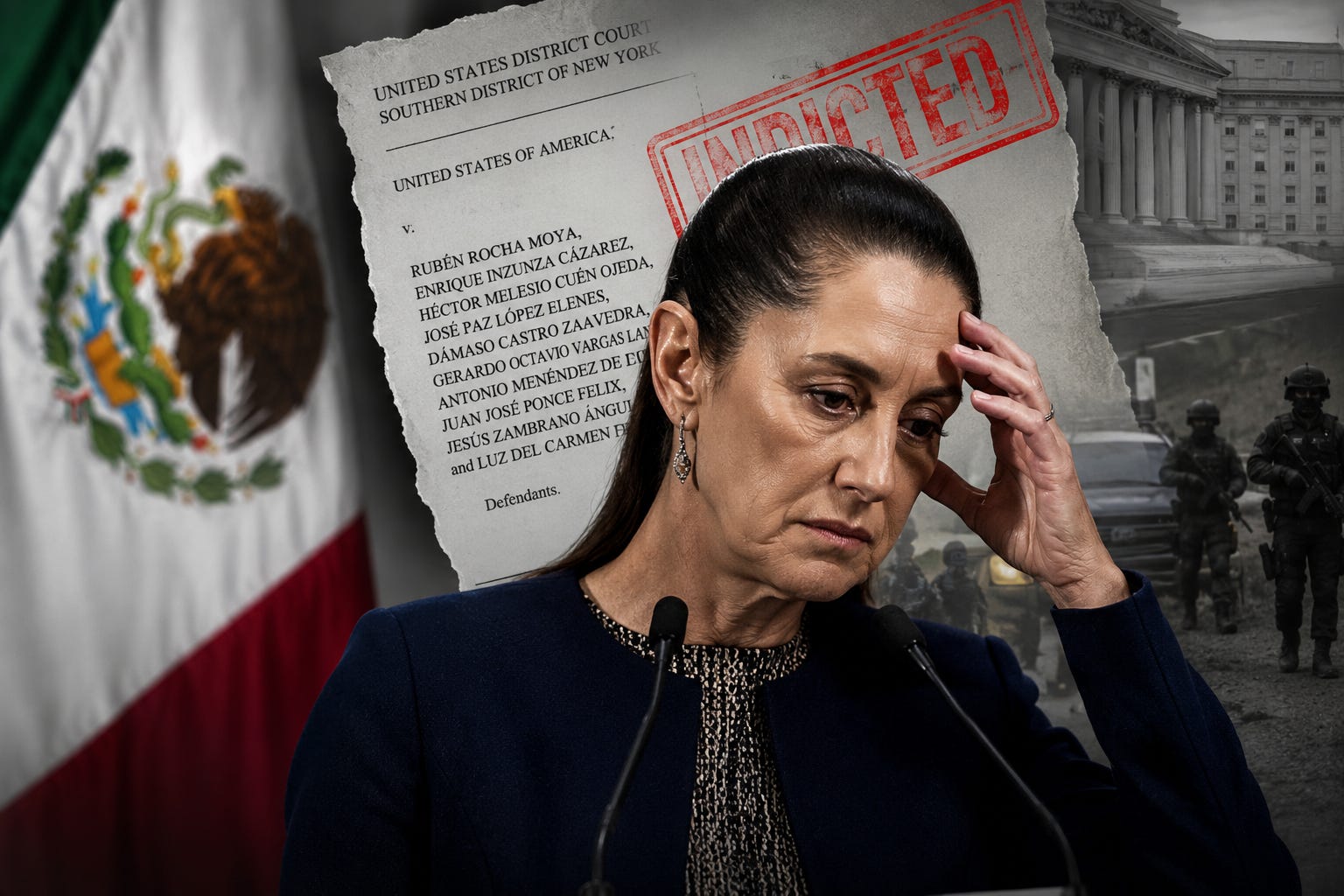
On April 29, federal prosecutors in Manhattan unsealed an indictment against Rubén Rocha Moya, the sitting governor of Sinaloa, Mexico, and nine other officials of his state government. Among the charged are a sitting Mexican senator, the mayor of the state capital, Culiacán, the deputy attorney general of the state, the former secretary of public security, and the former director of the state’s investigative police. All belong to Morena, the ruling party of Mexican President Claudia Sheinbaum and her predecessor and political mentor, Andrés Manuel López Obrador.
Morena, short for Movimiento Regeneración Nacional, is the populist-left movement that has governed Mexico since 2018 and now controls 22 of 31 state governorships and both houses of the federal Congress. The U.S. Department of Justice had never before sought the extradition of a sitting Mexican governor for narcotics offences. Rocha alone faces a forty-year mandatory minimum and the possibility of life in prison.
What looked extraordinary on Wednesday looks structural by the second week.
Follow-up reporting in the Spanish daily El País, based on the prosecutors’ filings, immediately reframed the case. The original allegation was that a sitting governor had taken bribes. The new allegation is that the cartel which paid them had also installed him in office. According to the filings, Rocha met with Iván and Ovidio Guzmán López, two of the sons of Joaquín El Chapo Guzmán and the current leaders of the Sinaloa Cartel faction known as Los Chapitos, the little Chapos, before the 2021 election. The meeting was protected by armed gunmen. The brothers told Rocha he would win the upcoming election if, once installed, he placed officials sympathetic to their operation throughout the Sinaloa state government.
Prosecutors allege that Rocha gave the cartel a list of his political opponents, with home addresses, so they could intimidate them out of the race. On the day before the June 2021 vote, at least nine election operators from the PRI (the Institutional Revolutionary Party, Mexico’s century-old former ruling party) and from Morena itself were kidnapped in Culiacán and in Badiraguato, El Chapo’s home region. Local media reported the kidnappings at the time. They did not connect them to the candidate.
The connection has now been made by a federal grand jury in New York. The Mexican press is making the rest. Carlos Loret de Mola, one of Mexico’s most prominent investigative journalists, working from sources inside President Sheinbaum’s own security cabinet, has reported that at the start of Sheinbaum’s term, Rocha asked the Mexican army’s senior commanders to halt a planned operation against the leadership of Los Chapitos. Loret has also reported that former President López Obrador knew of the original 2021 pact between Rocha and the cartel. Sheinbaum has publicly denied the reporting. The denials are pro forma. The pattern the columns describe matches what U.S. prosecutors have filed.
President Sheinbaum’s formal response has been procedural rather than substantive. Her Foreign Ministry has stated that the documents accompanying the U.S. extradition request lack sufficient evidence. Sheinbaum has dismissed the indictment’s central exhibit, a handwritten ledger of bribe amounts, as a sheet of paper with names and figures. She insists that any action against Rocha must comply with Mexican law and be filed with the Federal Attorney General’s Office, known by its Spanish initials, FGR. Her formal posture is that no foreign government will decide the future of the Mexican people. Truth, justice, and the defence of sovereignty.
The framing is a tell. Sheinbaum is not arguing that Rocha is innocent. She is arguing that the question of his innocence belongs to her, not to a Manhattan grand jury. That position is coherent only if Mexican institutions can be expected to actually adjudicate it. The track record does not support the expectation. The Frente Cívico Sinaloense, a citizens’ watchdog group, has documented more than two hundred kidnapping victims from the 2021 election, all of whom filed complaints with the FGR. None of those complaints has prospered.
The PRI’s formal challenge to the 2021 election results fell to the Sinaloa State Electoral Tribunal, where the magistrate who drafted the ruling validating Rocha’s victory was Aída Inzunza Cázares, the sister of one of the indicted senators, Enrique Inzunza Cázarez. In 2024, Rocha was named directly by a captured Sinaloa Cartel boss, Ismael El Mayo Zambada, in a public letter in which Zambada said he had been on his way to a meeting with Rocha when he was kidnapped and handed over to U.S. authorities. Sheinbaum, then president-elect, defended Rocha the same day. The FGR did not investigate.
The leaves of absence have become a procession. Rocha stepped aside on May 2 for a period exceeding thirty days. The state congress installed his close ally, Yeraldine Bonilla Valverde, as interim governor. The mayor of Culiacán took leave the same weekend. The deputy attorney general, accused of receiving $11,000 a month from Los Chapitos to leak operations and shield arrests, took leave on May 5. Their leaves are described as voluntary cooperation with the Mexican state’s investigation. They function as flight from the U.S. one.
The legal mechanics now cut against extradition. Sitting Mexican governors and federal senators hold procedural immunity, known in Mexican law as fuero, meaning the official privilege from prosecution. Stripping it requires what Mexicans call a desafuero, an impeachment-style vote in the federal Chamber of Deputies that lifts the privilege. The opposition Citizens’ Movement party filed such a request on May 1.
The Chamber, however, is in recess until September 1. In the interim, admissibility of such requests falls to a smaller body called the Permanent Commission, on which Morena holds a comfortable majority and whose members have publicly backed Rocha. A former Mexican Supreme Court justice now advising Sheinbaum has noted that by stepping down, Rocha technically lost his blanket immunity. The argument is technically correct and politically inert unless the FGR acts on its own, which it has not done in any comparable case.
The bilateral context has hardened further. On April 19, two American officers, identified by the Associated Press as CIA agents, were killed in a car crash in the Mexican state of Chihuahua while returning from a clandestine drug-lab raid that the Mexican federal government says it had not authorized. The Chihuahua state attorney general resigned on April 27 after acknowledging he had given the public inconsistent accounts of the foreign role in the operation. The intelligence operations are how the legal proceedings are built.
American economic pressure is already operational. Reuters reported in October 2025 that more than fifty Morena-affiliated politicians have had their U.S. visas revoked, with dozens of additional officials from other parties affected. The House Foreign Affairs Committee has declared the indictments only the beginning, pairing Rocha’s name with that of the ousted Venezuelan strongman Nicolás Maduro. The Manhattan U.S. Attorney has signalled more indictments to come.
Beyond the legal and economic tracks stands President Trump’s stated doctrine. In a Fox News interview with Sean Hannity in January, Trump said the United States had “knocked out 97 percent of the drugs coming in by water,” and would “start now hitting land with regard to the cartels.” He added: “The cartels are running Mexico. It’s very, very sad to watch and see what’s happened to that country.” Trump has separately said he offered to send U.S. troops into Mexico and that Sheinbaum refused because she is “very scared.”
The operational evidence already supports the doctrine. In February, U.S. surveillance assets supported the operation that killed Nemesio Oseguera, alias El Mencho, the leader of the Jalisco New Generation Cartel, Mexico’s second-largest criminal organization. NBC News reported in November that the U.S. military was training for ground operations in Mexico. The new U.S. National Drug Control Strategy commits the administration to use “all available diplomatic, intelligence, military, and economic tools” against designated cartels. And then there is the Maduro precedent. In January, U.S. special forces removed the Venezuelan president from Caracas and brought him to face trial in New York.
Mexico is not a bystander to the Maduro case. It runs through it. The superseding indictment against Maduro, unsealed the same day he was captured, names the Sinaloa Cartel as one of the partner organizations of his alleged Cartel de los Soles, the Cartel of the Suns, the name prosecutors use for the criminal network embedded in the Venezuelan military. One of the cornerstone allegations involves a 5,600-kilogram cocaine shipment dispatched from Venezuela aboard a DC-9 jet that landed at Ciudad del Carmen Airport in Campeche, on Mexico’s Gulf coast, in 2006.
The cooperators whose testimony is expected to convict Maduro will describe a Latin American narcotics ecosystem in which Mexico is the principal transshipment point. Mexico, in other words, will keep appearing in U.S. federal courtrooms long after the Rocha case is resolved, and the country’s official posture on each new appearance will be calibrated against the precedent Sheinbaum sets now.
The double standard in Sheinbaum’s evidentiary demand matters here. Over the past fifteen months, her government has, outside any extradition process, transferred more than ninety individuals to face U.S. courts on cartel-related charges, including Rafael Caro Quintero, the trafficker behind the 1985 murder of DEA agent Enrique Camarena, and the operatives killed alongside El Mencho in February. Mexican legal experts describe the practice as akin to forced exile, in tension with constitutional protections for Mexican citizens. For those targets, the evidentiary bar was minimal. For Rocha, the bar is “clear and irrefutable evidence” adjudicated under Mexican law by the FGR. The difference is not jurisprudential. The difference is that Rocha is Morena.
What to watch in the coming days is concrete. First, whether the Permanent Commission will deem the desafuero request admissible or bury it until September. Second, whether the FGR moves from reviewing the U.S. evidence to opening a formal criminal investigation. Third, whether U.S. prosecutors unseal additional indictments naming officials closer to the federal level, with the López Obrador circle the obvious next ring. Fourth, whether the Trump administration tightens tariffs on Mexican exports, adds Treasury sanctions, or expands the visa revocations. Fifth, whether anyone inside Los Chapitos in U.S. custody is named as a cooperating witness in a superseding indictment. Sixth, whether the renegotiation of the U.S.-Mexico-Canada trade agreement, opening for review this summer, becomes the lever that forces the issue.
The escalation risks need to be named plainly. Trump has stated the doctrine of land strikes against cartels. He treats the Mexican government’s protection of indicted Morena officials as the predicate that exposes the country to unilateral American action. The designation of six Mexican cartels as foreign terrorist organizations, in force since February 2025, supplies the legal framework. The intelligence and operational pieces are in place. The Maduro removal demonstrated political will. A targeted U.S. strike on a Chapitos site inside Sinaloa is no longer the analytical outlier it was a year ago. A renewed offer of U.S. troops to operate inside Mexico, this time formalized rather than informal, is plausible. So is the lower-tier option of expanded covert intelligence operations of the kind that produced the April 19 deaths in Chihuahua. None of this requires Mexico’s consent. All of it becomes politically easier each week Sheinbaum holds the sovereignty line on Rocha. The longer she stalls, the better the case for action looks to Washington.
The comparison now operative in Mexican commentary is the one Loret de Mola crystallized at the outset. Rocha is Mexico’s García Luna moment. Genaro García Luna was the secretary of public security under President Felipe Calderón from 2006 to 2012, the most senior law-enforcement official in Mexico, the man who was supposed to be running the war on the cartels. He was convicted in a New York federal court in February 2023 of accepting millions of dollars in bribes from the Sinaloa Cartel in exchange for protecting its operations. He was sentenced in October 2024 to thirty-eight years in prison. The difference between García Luna and Rocha is that García Luna was prosecuted after his patron, Calderón of the centre-right PAN party, was out of power. Rocha was named while his patron’s chosen successor still sits in the National Palace.
Sheinbaum is making the calculation López Obrador made with Salvador Cienfuegos in 2020. Cienfuegos was the general who served as Mexico’s secretary of defence under former President Enrique Peña Nieto, the chief of the entire Mexican army. He was arrested at Los Angeles International Airport in October 2020 on U.S. trafficking charges, accused of protecting the Beltrán Leyva cartel in exchange for bribes. After a furious diplomatic campaign by López Obrador, U.S. Attorney General William Barr agreed within weeks to drop the charges and return Cienfuegos to Mexico for prosecution under Mexican law. Mexico never prosecuted him. The case is the template Sheinbaum is following. But the variables have shifted. The Trump of 2026 is less interested in diplomatic continuity than the Trump of 2020. The cartels carry a foreign terrorist designation that did not exist five years ago. The indictment names a sitting governor of her own party rather than a retired general from someone else’s. The underlying evidence is being corroborated daily by Mexican sources. And the Trump of 2026 has already done in Caracas what the Trump of 2020 only threatened.
§
The sovereignty argument is intelligible. Whether it survives contact with the next disclosure or with the next strike is the question.
Mexico is holding its breath. So is the bilateral relationship. So, increasingly, is the question of what sovereignty means when the country that claims it refuses to police itself.
As always, Sir, you tie together many threads. I am not whatsoever knowledgeable about Latin America other than the faint coverage in Canadian media, such as it is. {"Such as it is" is meant to cover both the sparse coverage by Canadian media and the sparseness of reliable media in Canada.]
It is clear that many countries suffer from institutionalized crime; we in Canada and our friends in the US [yes, I do call Americans "friends"] also suffer from such institutional malfeasance. Having said that, as near as I can tell, it is much less in Canada and the US than in much of the world but we do need to be wary and work hard to avoid the traps by which such illegality becomes normalized throughout society. I won't speak to the US but I fear that in Canada there is insufficient recognition in governments (plural, to be sure) of the problem.