
The Prophet Cannot Concede
Gustavo Petro governs Colombia from revelation. An election is not a revelation, and that is why he cannot lose one cleanly.

What is a citizen supposed to do with a president who says the ballot can darken the moral planet?
In Córdoba, five days before Colombians chose his successor, President Gustavo Petro stood at a land-titling event and said something similar. Colombia is the heart of the world (el corazón del mundo), he told the crowd, and from it we can determine its palpitations and vibrations (podemos determinar sus palpitaciones y vibraciones).
Vote the wrong way, he warned, and we can unleash the death of the spectres, and the planet will darken morally and ethically, and Colombia will fall silent before the peoples of the world (podemos desatar la muerte de los espectros y se oscurecerá el planeta moral y éticamente). An ordinary runoff became a referendum on the life of the planet.
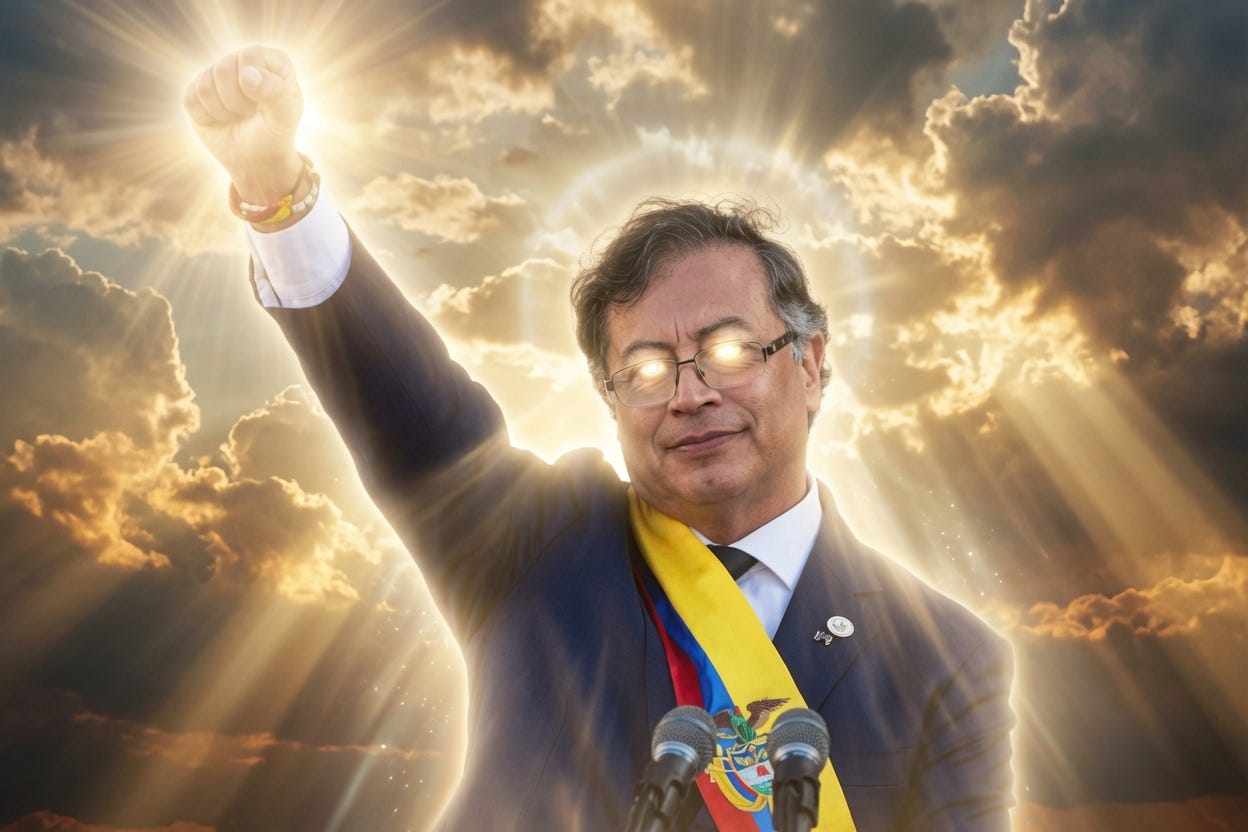
Petro improvised none of it.
The apocalyptic key sounded from his first day on the world stage. At the United Nations in 2022, he announced that the climate models foretold the end of the human species (el fin de la especie humana), its time no longer a matter of centuries.
Two years later, at the biodiversity summit in Cali, he compressed the thought into a phrase: what we are living is worse than the apocalypse (peor que el apocalipsis). The vocabulary never changes, and it is never the vocabulary of government. A finance minister speaks of deficits. Petro speaks of extinction.
Where does a head of state acquire this register? He has told us twice, in his own voice.
The first source is indigenous, he tells us. The Kogi and their neighbours in the Sierra Nevada de Santa Marta call their mountain the heart of the world and hold themselves its elder brothers, guardians of a living planet who warn that the younger brother’s greed is killing it.
Petro met the idea as a young man and kept it. At COP16, he narrated the moment plainly: as a young man, I went up to that Sierra and walked the paths and met the descendant Indians, and they told me again that I stood in the heart of the world, and the idea stayed in my head (y me quedó la idea en la cabeza).
The second source is scriptural. Installing Congress in 2023, he confessed a fondness for the Book of Revelation, which he had read in prison and found passionate and poetic (pasional y poético). An indigenous cosmology of planetary guardianship, married to the Apocalypse of St. John.
Constitutional government assumes that political truth is provisional, revisable and subject to electoral correction. Prophetic government assumes truth has already been revealed. Elections, therefore, become confirmations rather than tests. Once that assumption enters politics, defeat ceases to be legitimate because revelation cannot be outvoted.
Their offspring is a politics that reads every contest as the final battle between life and death. This is consistent with earlier radical revolutionaries in Twentieth-Century Latin America.
Watch how the parts fit in Petro. Colombia sits at the center of creation. Its president guards life (la vida), and his opponents serve greed (la codicia), which he treats as death. The binary leaves no room for ordinary disagreement, because disagreement with life ceases to be a policy preference and becomes a moral eclipse.
On election day in June, he wore a small Aramaic letter on his chest and explained that the mark was no crucifix; it was the final letter of the alphabet that Jesus the Palestinian (Jesús palestino) spoke (more on this in a future post), signifying that the last shall be first. He promised to visit the Pope once the voting closed. A president who dresses his campaign in the vestments of prophecy is telling you what kind of authority he believes he holds.
The trouble begins here, and its nature is constitutional rather than mystical.
An election and a revelation obey different grammars. A prophet issues a warning that history will vindicate or ignore, and no ballot can overturn it, only disbelief. A citizen casts a vote that settles a question for four years and reverses it at the next. Petro fused the two.
When he told Colombians that refusing his succession would put out the light of the world, he pushed the ordinary democratic outcome outside the range of the thinkable. Within his own frame, defeat cannot mean that voters preferred another programme. Defeat can only mean that the spectres of death have seized the heart of the world. His words.
So consider what came next.
On 21 June, Colombians chose, and they chose the other man. Abelardo de la Espriella beat Petro’s candidate, Iván Cepeda, by 49.7 percent to 48.7 percent, a margin of nearly a quarter of a million votes, and the presidency changes hands on 7 August. A quarter of a million citizens, in a country of fifty-two million, declined to accept that their ballot governed the palpitations of the planet.
Within hours, the guardian of life went to social media to allege that the system was accepting tally sheets without the signatures of the polling juries. In effect, he suggested that the count itself could not be trusted.
From medieval peasant prophets to Louis Riel, from Sandino to Che Guevara, these radical political figures never accept earthly authority derived from popular choice. When they claim to follow popular choice, it is rooted in an otherworldly source (More on this in a future post).
Governing by revelation reaches its predictable terminus here. A leader who has spent four years insisting that his cause is life itself cannot afford a clean defeat, because a clean defeat would concede that life itself stood on the ballot and finished second. The prophecy forbids the concession. So the count becomes the culprit. This is the typical pattern.
While Latin America has watched this liturgy before, what sets Petro somewhat apart is the sincerity of the cosmology, the genuine welding of Sierra Nevada guardianship to Johannine apocalypse into a doctrine of state. Like the subjects I wrote about in my doctoral studies, he appears to believe it. It does not seem to be a manipulative ruse. That offers no comfort. It is the reason the belief is dangerous.
A president who governs from revelation does not lose an election. An election betrays him. Stay tuned.
Marco Navarro-Génie - Love your columns. Quite often you provide insight about what is really happening in Latin America. I used to spend quite a bit of time in Colombia back in the 90's and almost moved there. I really don't know much about Petro, but from your comments, this guy must have a bigger head than Pablo Escobar. My wife is from Mexico City and you have had some pretty interesting comments on Mexico as well. Keep up the good work. Que tengas un buen fin de semana.
This sort of analysis cannot be found elsewhere. You've expanded my understanding of LatAm substantially.